Introduction
Estimating rock mass quality is a key step in geotechnical design, but it's often slowed down by inconsistent descriptions and manual chart reading. The Geological Strength Index (GSI) provides a practical way to translate rock mass structure and discontinuity surface condition into a single index that can be used for rock mass strength and deformability estimates. In this post, I'll walk through what GSI is, how to interpret it from core logging, and how an online GSI calculator can speed up the workflow while keeping your assumptions transparent. I'll also include a worked example using a core log so you can see how to go from observations to a defendable GSI range.
Core Logging Provides Data to GSI Calculator
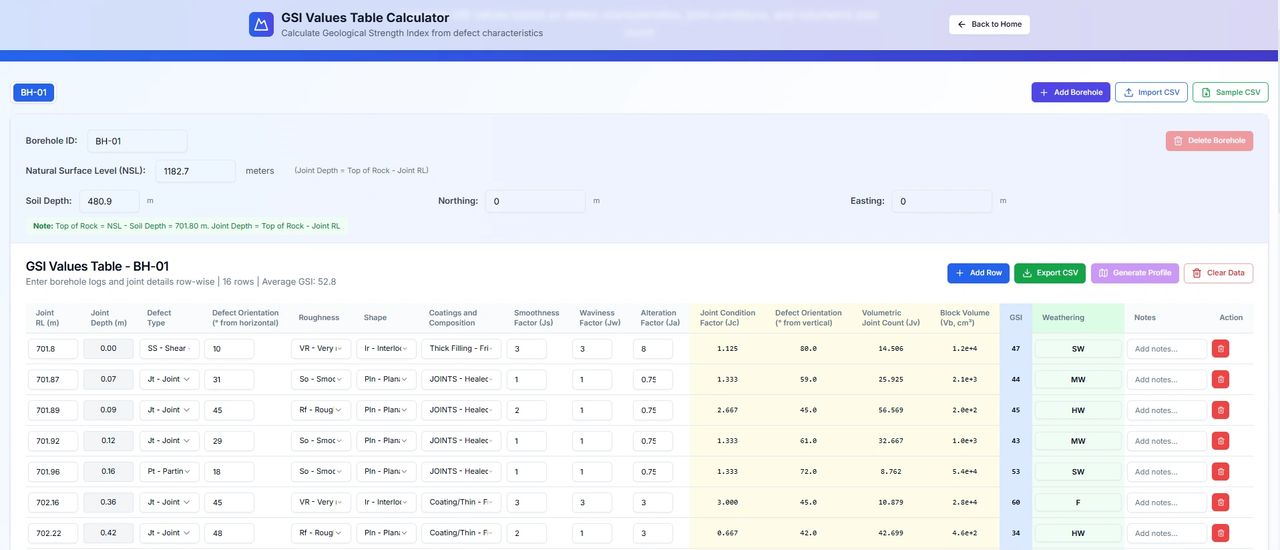
GSI Calculator is not the substitute of Core Logging, but they compliments each other. The natural defects data from core logging is used in GSI Calculator to verify the weathering condition predicted from core logging as shown in Figure 2.
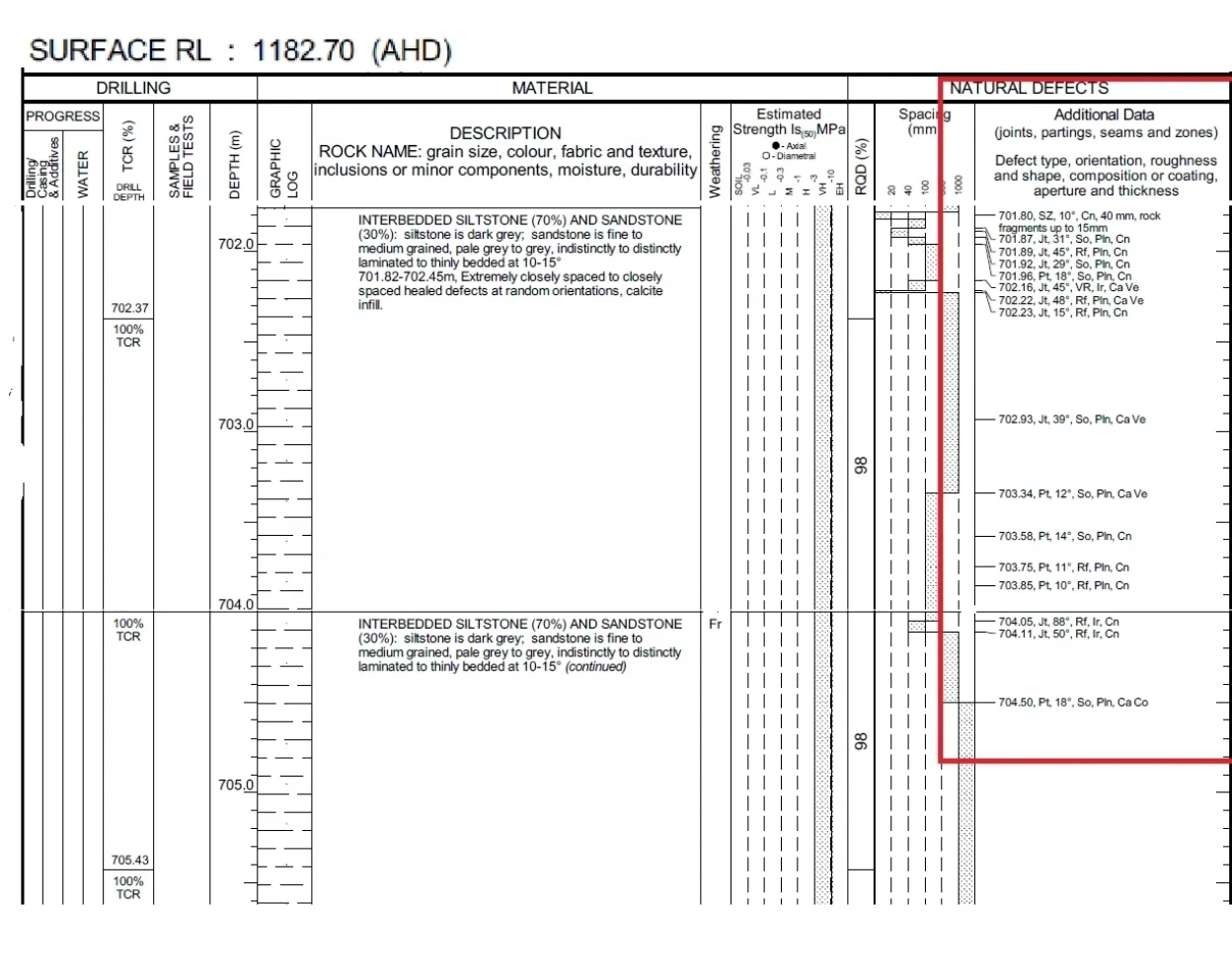
Figure 3 is showing defects conditions in Core log on left hand side and in GSI calculator on right side. The sequence of properties of each defect in core log are:
- RL of defect
- Defect type
- Angle of defect from horizontal
- Roughness
- Shape
- Coatings and Composition
This is recommended sequence in AS 1726 (Geotechnical site Investigation). Similarly GSI calculator has adopted the same sequence.
.png/:/cr=t:0%25,l:0%25,w:100%25,h:100%25/rs=w:1280)
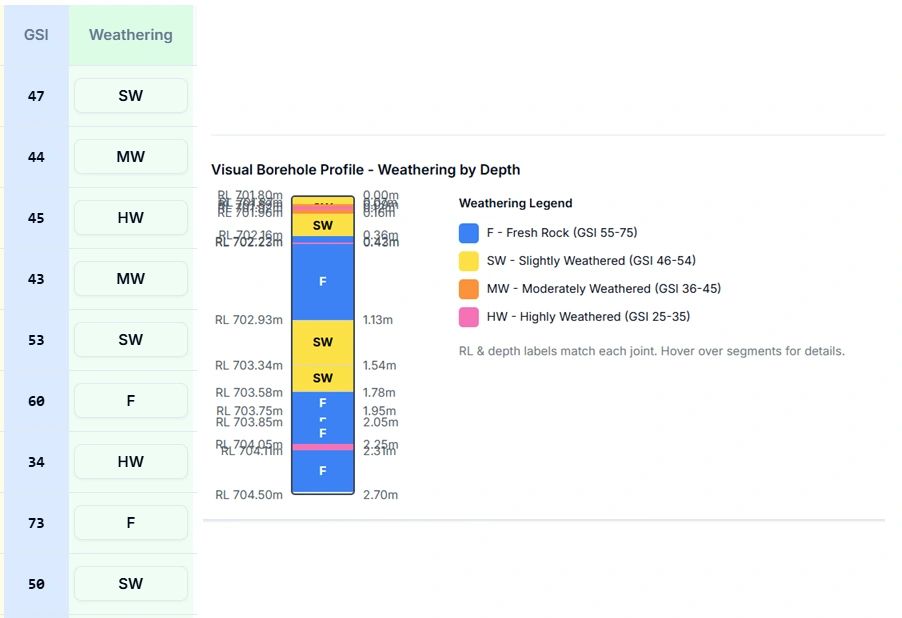
In Figure 3, I have used the same defect properties from core log sheet in calculator to determine GSI values till RL 704.50m. If you see the Figure 2, the weathering condition is only F-Fresh while in calculator the weathering condition and GSI and weathering are varying along the depth as shown in Figure 4.
Conclusion
Determining the Geological Strength Index (GSI) from core logging is a practical and reliable way to translate observed rock mass conditions into meaningful design inputs for geotechnical engineering. By carefully assessing rock structure, discontinuity condition, blockiness, weathering, and surface characteristics in drill core, engineers can develop a realistic GSI estimate even at the investigation stage.
While the method involves a degree of engineering judgement, consistency in logging, use of standardised descriptions, and correlation with field observations can greatly improve confidence in the result. GSI should not be treated as a fixed number, but rather as an interpreted range that reflects the natural variability of the rock mass.
Ultimately, when core logging is completed systematically and interpreted with experience, GSI becomes a valuable bridge between site investigation data and rock mass design, supporting better decisions for slope stability, tunnel design, foundations, and excavation works.
References
Measurement and Characterisation of Rock Mass Jointing by Arild Palmström, Övre Smestad vei 35e, N-0378 Oslo, Norway
In-Situ Characterization of rocks Editors: V.M. Sharma and K.R. Saxena (2001) A. A. BALKEMA PUBLISHERS LISE / ABINGDON / EXTON (PA) / TOKIO
Determination of residual strength parameters of jointed rock masses using the GSI system M. Cai, P.K. Kaiser, Y. Tasaka, M. Minami