A Comprehensive Digital Solution for Modern Rock Engineering
Introduction
In the demanding world of geotechnical engineering, accurate calculation of rock mass properties is not just a convenience it's a necessity.
Underground excavations, tunnel design, slope stability analysis, and mining operations all depend on reliable rock mass characterization. Today, Geotechnical Designs is proud to introduce a game-changing digital platform that transforms how engineers analyse rock mass behaviour: Calculate Rock Mass Properties (available at rockmassproperties.geotechnicaldesigns.com.au) 👈.
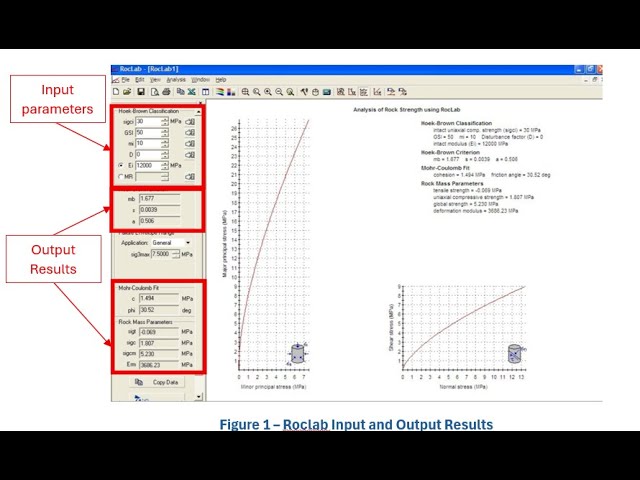
This powerful web-based application brings together decades of rock mechanics research, specifically the globally-recognized Hoek-Brown failure criterion, and combines it with modern computing capabilities to deliver instant, accurate, and comprehensive rock mass analysis directly to your browser.
The Power of the Hoek-Brown Criterion at Your Fingertips
1. Scientific Foundation
At the heart of our platform lies the Hoek-Brown failure criterion the most widely accepted empirical relationship for estimating rock mass strength. Developed by Professors Evert Hoek and E.T. Brown, this criterion has become the industry standard for characterizing the strength and deformation properties of jointed rock masses. Our application implements the complete Hoek-Brown methodology, including:
- Generalized Hoek-Brown criterion for rock mass strength
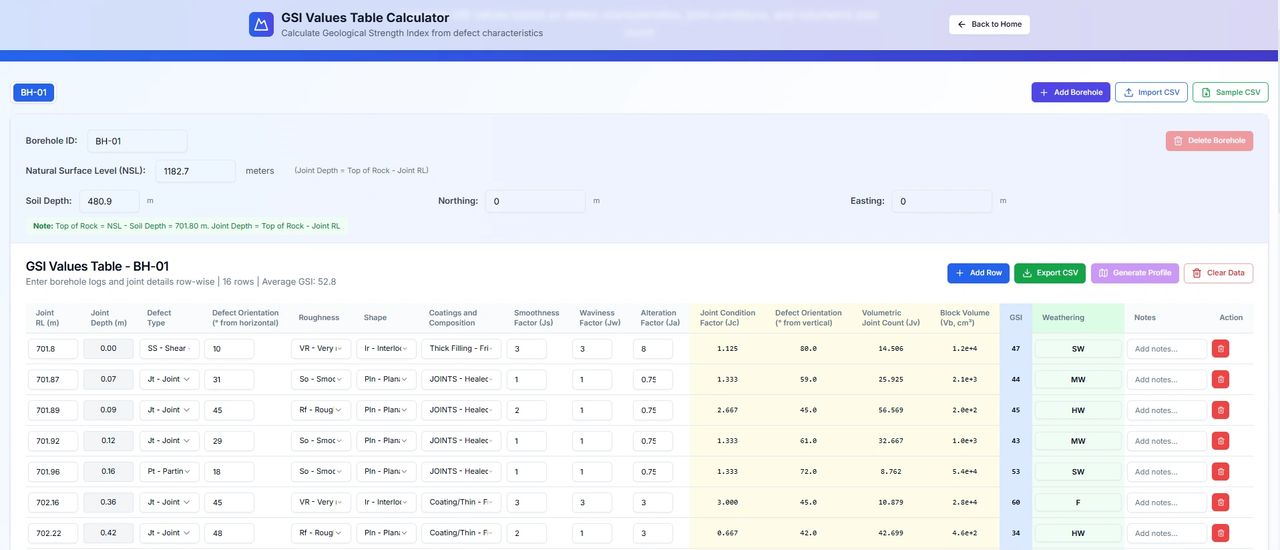
- GSI (Geological Strength Index) quantitative calculations
- Disturbance factor (D) considerations for excavation damage
- Material constant (mi) database for various rock types
- Rock mass modulus (Erm) estimation
All above parameters details you will find in our calculator in Educational Resources.

2. Instant Results, Professional Accuracy
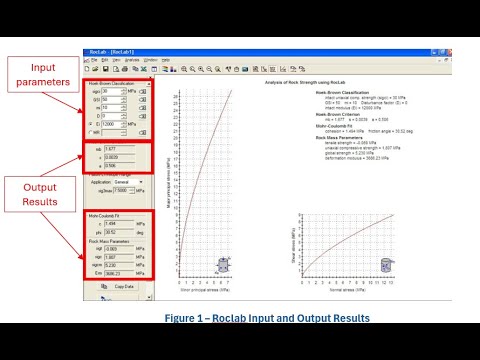
What traditionally required complex spreadsheets, manual calculations, and extensive reference checking can now be completed in seconds. Engineers simply input their field data rock type, GSI value, uniaxial compressive strength, and excavation parameters and the platform instantly computes:
- Hoek-Brown parameters (mb, s, a)
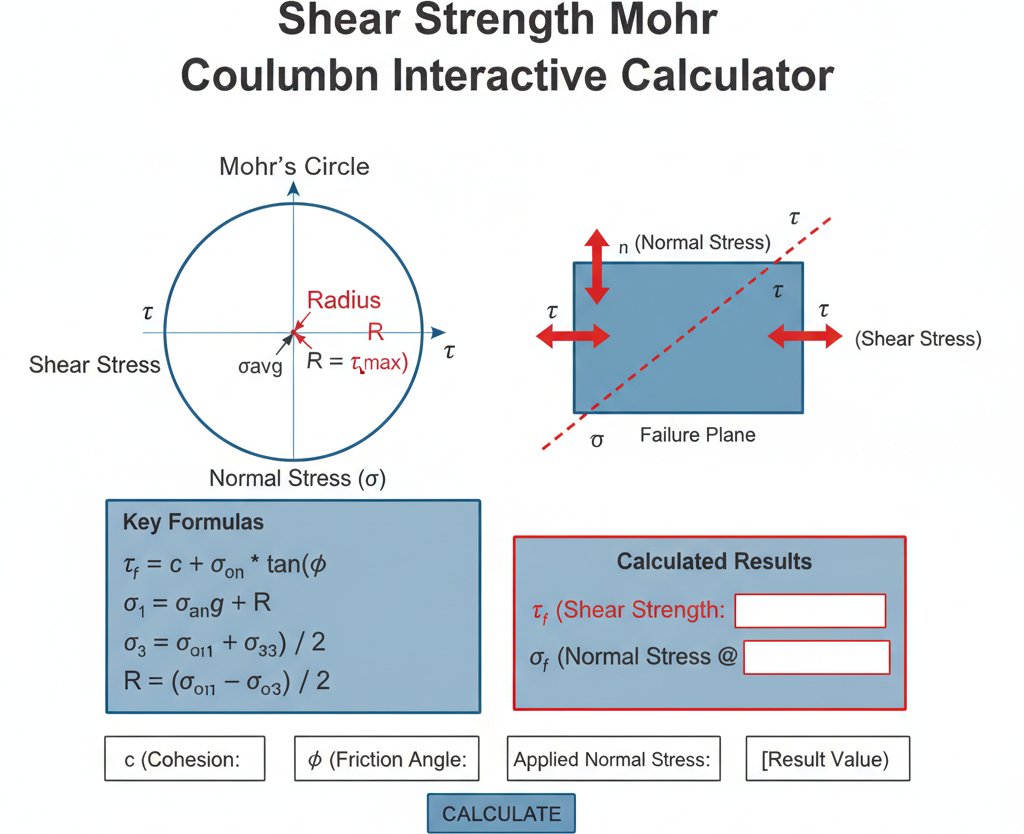
- Rock mass strength parameters (cohesion, friction angle)
- Deformation modulus (Erm)
- In-situ stress conditions (vertical and horizontal stresses)
- Tunnel deformation analysis (radial displacement, strain, convergence)
- Rock mass quality classification
Key Features That Set Us Apart
1. Comprehensive Single Calculator
Single calculator will provide results to only one set of input data along with Failure Envelope. Failure Envelop facility is not provided in batch calculator.
2. Advanced Batch Processing
For projects requiring parametric studies or multiple borehole analysis, our Batch Calculator revolutionizes workflow efficiency:
- CSV Upload/Download: Import field data directly from spreadsheets
- Multiple Scenarios: Process dozens of calculations simultaneously
- Comparative Analysis: Evaluate different GSI values, depths, or rock types in parallel (coming soon)
- Instant Export: Download complete results for reporting
Real-World Application:
Imagine analysing 50 different tunnel sections along a proposed alignment in minutes rather than hours. Or evaluating the impact of varying GSI estimates across a range of 40-70 to understand sensitivity. This is the power of batch processing.
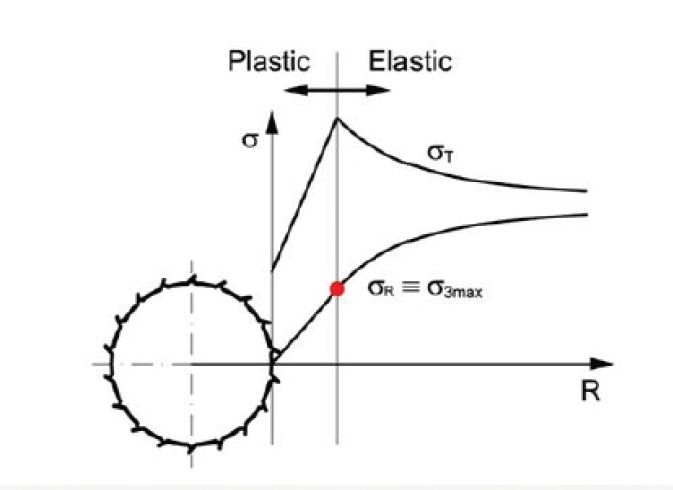
4. Stress and Strain Analysis Around Tunnels
Understanding ground behaviour around excavations is critical for safe design. Our platform provides detailed stress-strain analysis:
In-Situ Stress Calculations:
- Vertical stress: σᵥ = γ × H
- Horizontal stress: σₕ = K × σᵥ (with adjustable lateral earth pressure coefficient)
Tunnel Deformation Analysis:
- Radial displacement at tunnel boundary
- Strain percentage (ε%)
- Absolute deformation in millimeters
- Severity classification (Minimal, Moderate, Significant, Severe, Critical)
5. Real-World Applications
Tunnel Design Projects
Consider a 5km road tunnel through variable geological conditions:
- Field Investigation: Conduct drilling at 200m intervals (25 boreholes)
- GSI Determination: Use our multi-borehole GSI calculator to process defect data from each location
- Batch Analysis: Upload all 25 borehole locations to batch calculator
- Results: Obtain complete rock mass properties, deformation predictions, and support requirements along entire alignment
- Time Saved: Days of spreadsheet work reduced to hours
Mining Ground Support Design
For an underground metal mine:
- Rock Mass Characterization: Analyze core logging data using GSI calculator
- Stress Analysis: Calculate in-situ stresses at various depths (100m to 1500m)
- Support Estimation: Predict radial displacement for different excavation sizes
- Optimization: Run parametric studies to optimize stope dimensions
- Outcome: Safe, economical ground support design based on quantitative analysis
Slope Stability Assessment
For open pit or cut slope projects:
- Material Properties: Determine rock mass strength parameters (c', φ')
- Multiple Scenarios: Evaluate different GSI estimates for uncertainty analysis
- Design Parameters: Export results to slope stability software
- Documentation: Generate professional reports with calculated parameters
References
Our calculations align with:
- Hoek, E., Carranza-Torres, C. & Corkum, B. (2002). Hoek-Brown failure criterion - 2002 edition
- Hoek, E., Kaiser, P.K. & Bawden, W.F. (1995). Support of Underground Excavations in Hard Rock
- Palmström, A. (1995). RMi - a rock mass characterization system for rock engineering purposes
- International Society for Rock Mechanics (ISRM) guidelines